Restore missing teeth with natural-looking porcelain bridges at Anderson Smile Center. Completed in two appointments. Most PPO insurance accepted. Serving Anderson Township and greater Cincinnati since 1973.
Honestly, a missing tooth affects more than just how you look. It changes the way you chew. It shifts the teeth around it. It can make you self-conscious in ways you don’t expect – avoiding certain foods, covering your mouth when you laugh, or just feeling like something is off. A dental bridge fixes all of that. And it does it faster and more simply than most people realize.
At Anderson Smile Center, we’ve been restoring smiles for patients across Cincinnati and Anderson Township for over 50 years. Dr. Aakriti Chaudhry, and Dr. Atul Deshmukh place dental bridges using high-quality porcelain materials that match your natural teeth in color, shape, and translucency. Most patients complete the entire process in two appointments, with a temporary bridge in place between visits so you’re never without a full smile.
We serve patients from Anderson Township, Hyde Park, Newtown, Amelia, Milford, Cherry Grove, Fairfax, Mariemont, and across the greater Cincinnati area. If you’ve been living with a missing tooth – or if you have a tooth that’s failing and needs to come out – a dental bridge consultation is a good first step. We’ll take a look, walk you through your options, and give you a clear picture of what to expect.
Here’s the thing – the longer a missing tooth goes unaddressed, the more the surrounding teeth shift and the bone underneath resorbs. The sooner you restore it, the simpler the process and the better the long-term outcome.
Bridges aren’t just for obvious gaps. Here are the situations where a bridge is often the best solution.
A dental bridge is designed specifically to replace one to three consecutive missing teeth. If you have a gap in your smile – whether from an extraction, injury, or tooth loss – a bridge restores full function and appearance.
If the teeth on either side of the gap are already damaged, decayed, or in need of crowns, a bridge is an efficient solution – the crowns that anchor the bridge also restore those teeth at the same time.
Dental implants require a surgical procedure and several months of healing. A bridge achieves a similar result without surgery – making it the preferred choice for patients who want a faster solution or who are not ideal implant candidates.
Missing teeth shift the bite load to remaining teeth, causing uneven wear and chewing difficulty. A bridge restores proper bite distribution so you can eat comfortably without favoring one side of your mouth.
Teeth naturally drift toward gaps over time. If you’ve noticed your teeth shifting since a tooth was lost or extracted, a bridge stops that movement and holds everything in proper alignment.
Unlike a removable partial denture, a dental bridge is cemented permanently in place. You brush and care for it like your natural teeth. There’s nothing to take in and out, and nothing that feels loose or uncomfortable.
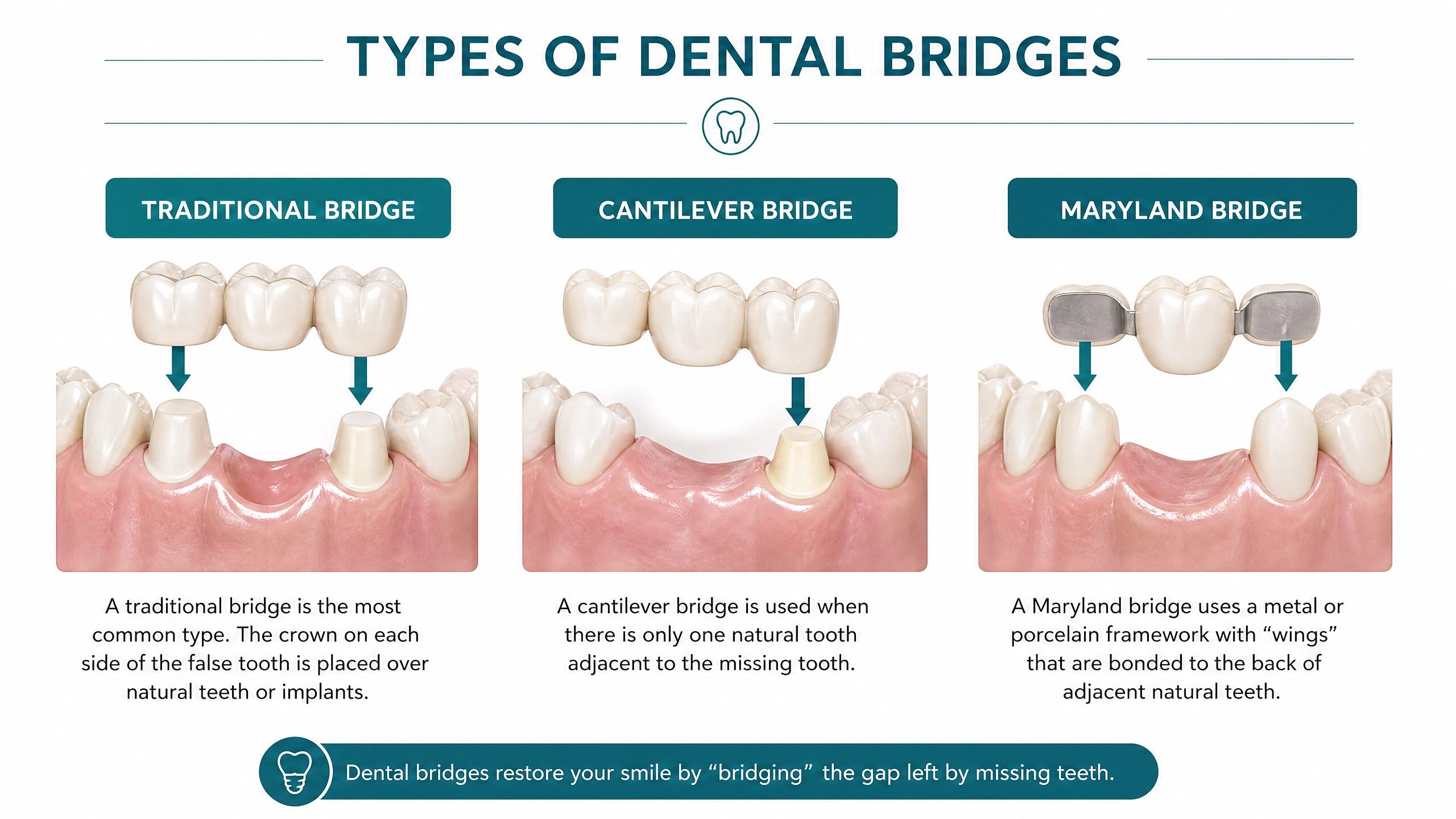
Not every bridge is the same. The right type depends on the location of the gap, the condition of the surrounding teeth, and your long-term goals.
The most common type. Two crowns are placed on the teeth on either side of the gap (the abutment teeth), with a false tooth (pontic) suspended between them. Strong, durable, and natural-looking. Works best when the neighboring teeth are healthy enough to serve as anchors.
Used when there is only one natural tooth adjacent to the gap. The bridge is anchored to a single crown on one side. Less common than a traditional bridge, but appropriate in specific situations – particularly toward the back of the mouth where bite forces are lower.
A conservative option that uses a porcelain or metal framework bonded to the backs of the adjacent teeth – no crowns required. Best suited for front teeth where bite forces are minimal. Preserves more of the natural tooth structure on either side of the gap.
When multiple consecutive teeth are missing, an implant-supported bridge uses dental implants as anchors instead of natural teeth. This eliminates the need to crown healthy adjacent teeth and preserves the jawbone underneath. We’ll discuss whether this is the right option at your consultation.
The truth is, not all bridges are created equal. The quality of the materials, the precision of the fit, and the skill of the dentist placing it all make a significant difference in how natural it looks and how long it lasts.
At Anderson Smile Center, we use high-quality porcelain and porcelain-fused-to-zirconia materials that are custom-fabricated to match the color, shape, and translucency of your natural teeth. We take detailed impressions and work with a trusted dental lab to ensure the fit is precise before the bridge is permanently cemented.
Two appointments. Clear communication at every step. No surprises.
We examine the gap, the adjacent teeth, and the surrounding bone. We take X-rays to assess the health of the abutment teeth and discuss your options – including whether a bridge or implant is the better long-term choice for your specific situation.
At your first appointment, we prepare the abutment teeth by reshaping them slightly to accommodate the crowns. We take detailed impressions of your teeth and bite, which are sent to the dental lab. A temporary bridge is placed so you leave with a full smile.
Your permanent bridge is custom-fabricated by a skilled dental technician using your impressions. The shade is matched to your natural teeth. We review the bridge carefully before your second appointment to confirm the fit and appearance meet our standards.
At your second appointment, we remove the temporary bridge and cement the permanent one in place. We check your bite carefully and make any minor adjustments needed for comfort. Most patients leave feeling completely natural within a day or two.
We walk you through how to clean your bridge properly – including how to floss underneath it using a floss threader or water flosser. We schedule a follow-up check to confirm everything is comfortable and the gum tissue is healthy around the bridge.
Schedule a bridge consultation at Anderson Smile Center. Same-week appointments available.
We’ve been doing this for over 50 years. Here’s what that means for you.
Anderson Smile Center has been serving Cincinnati and Anderson Township since 1973. Our doctors have placed hundreds of bridges and bring genuine expertise to every case – not just technical skill, but the judgment that comes from decades of experience.
We use high-quality porcelain and zirconia materials that are custom shade-matched to your natural teeth. The difference between a well-made bridge and a mediocre one is visible every time you smile. We don’t compromise on materials.
We’ll tell you honestly whether a bridge or an implant is the better long-term option for your situation. We don’t push one solution over another. We explain the trade-offs clearly and let you decide what makes sense for your health and your life.
You don’t need a referral to a specialist you’ve never met. Your bridge is placed by the same doctors who handle your regular care, in the same office you already know and trust. That continuity matters – especially for restorative work.
We accept most major PPO dental insurance plans and verify your specific benefits before your appointment so you know exactly what to expect. CareCredit financing is also available for any out-of-pocket portion.
Between your preparation appointment and your final placement, we place a temporary bridge so you’re never without a complete smile. You leave your first appointment looking and functioning normally while your permanent bridge is being fabricated.
Both restore missing teeth effectively. The right choice depends on your specific situation, timeline, and goals.
| Factor | Dental Bridge | Dental Implant |
|---|---|---|
| Surgery Required | ✓ No surgery needed | Yes – implant post placed surgically |
| Treatment Timeline | 2 appointments over 2-3 weeks | 3-6+ months including healing |
| Bone Preservation | Does not prevent bone loss | ✓ Preserves jawbone |
| Adjacent Teeth Affected | Abutment teeth are crowned | ✓ No impact on adjacent teeth |
| Best When | Adjacent teeth need crowns; faster solution needed | Healthy adjacent teeth; long-term investment preferred |
| Longevity | 10-15+ years with proper care | 20+ years, often lifetime |
| Insurance Coverage | Typically covered (major restorative) | Often limited or not covered |
Not sure which is right for you? We’ll help you decide at your consultation – no pressure, just honest guidance.
Let me explain what actually happens when you come in for a bridge consultation. It’s not a sales pitch. It’s a proper clinical evaluation.
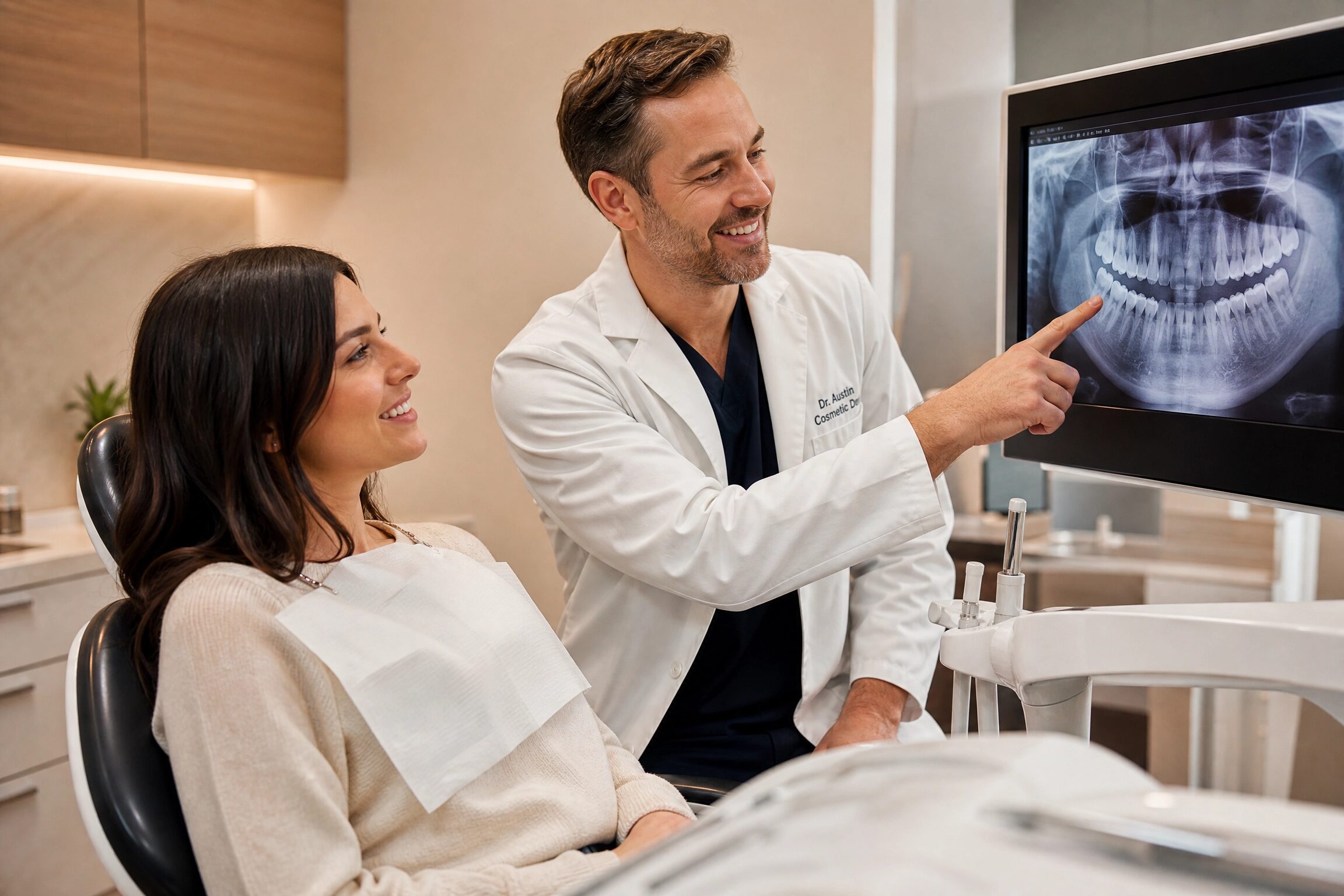
We take a panoramic X-ray to assess the bone, the adjacent teeth, and the overall health of your mouth. We look at whether the neighboring teeth are strong enough to serve as bridge anchors, whether there’s enough bone for an implant if that’s the better option, and whether there are any other issues that need to be addressed first.
Then we talk through your options clearly – what each one involves, how long it takes, what it costs with your insurance, and what the long-term trade-offs are. You leave with a complete picture, not just a treatment plan you didn’t fully understand.
Your bridge will be placed by one of our experienced, credentialed doctors – in the same familiar office where you receive your regular care.
General & Cosmetic Dentist
Dr. Chaudhry brings a strong cosmetic eye to restorative work – ensuring that bridges not only function perfectly but look completely natural. She takes particular care with shade matching and occlusal adjustment, so patients leave with a result that feels as good as it looks. Patients from Hyde Park and Mariemont regularly seek her out for cosmetic restorations.
General & Restorative Dentist
Dr. Deshmukh has extensive experience in both traditional and implant-supported bridge work. He’s particularly well-suited for complex cases involving multiple missing teeth or situations where the choice between a bridge and an implant requires careful evaluation. Patients appreciate his thorough, unhurried approach to treatment planning.
Real patients. Real results. From Anderson Township and across Cincinnati.
“I had a tooth extracted two years ago and kept putting off replacing it. Finally came in for a bridge consultation and I wish I’d done it sooner. The whole process was so much easier than I expected – two appointments, and the bridge looks completely natural. Dr. Nguyen matched the color perfectly.”
“Dr. Chaudhry was incredibly thorough at my consultation. She explained the difference between a bridge and an implant clearly, helped me understand what my insurance covered, and didn’t push me either way. I went with the bridge and I’m really happy with the result. It feels completely natural.”
“I was nervous about the procedure but the team at Anderson Smile Center made me feel completely at ease. The temporary bridge looked great and the permanent one is even better. I can eat normally again and I’m not self-conscious about my smile anymore. Highly recommend Dr. Deshmukh.”

You know what most patients tell us after their bridge is placed? That they forgot it was there. That’s the goal – a restoration so well-fitted and natural-looking that it just becomes part of your smile.
With proper care, your bridge can last 10 to 15 years or longer. The key is keeping it clean. We’ll show you exactly how to floss underneath it, which takes about 30 extra seconds per day. Beyond that, your regular cleanings at Anderson Smile Center are the most important thing you can do to extend its life.
We serve patients from Anderson Township, Hyde Park, Newtown, Amelia, Milford, Cherry Grove, Fairfax, Mariemont, Indian Hill, and across the greater Cincinnati area. If you’re ready to restore your smile, we’d love to help. Call us at (513) 474-5185 or book online to schedule your consultation.
We make it easy to understand your coverage before your appointment.
Most PPO dental insurance plans cover dental bridges as a major restorative procedure. We verify your specific benefits before your appointment so you know exactly what to expect.
CareCredit healthcare financing is available for any out-of-pocket portion of your bridge cost. Flexible monthly payment plans make it easy to move forward without delay.
Honest answers to the questions we hear most often.
A well-made dental bridge, properly cared for, typically lasts 10 to 15 years – and many last significantly longer. The lifespan depends on the material used, how well you maintain your oral hygiene, and whether you grind your teeth. Porcelain-fused-to-zirconia bridges tend to be the most durable. The most important thing you can do to extend the life of your bridge is to floss underneath it daily using a floss threader or water flosser, and to keep up with your regular cleanings at Anderson Smile Center.
The procedure itself is done under local anesthesia, so you won’t feel pain during the appointment. Some patients experience mild sensitivity or soreness in the prepared teeth for a few days after the appointment, which is completely normal as the gum tissue adjusts. This typically resolves on its own within a week. If you’re anxious about the procedure, nitrous oxide sedation is available at Anderson Smile Center to help you feel more relaxed throughout.
A dental implant replaces the root of the missing tooth with a titanium post that integrates with the jawbone, then supports a crown on top. An implant is the most permanent solution and preserves bone volume. A dental bridge spans the gap using the adjacent natural teeth as anchors – no surgery is required, and the process is completed in two appointments. Bridges are often the better choice when the neighboring teeth already need crowns, when bone loss makes implant placement complex, or when a faster, more affordable solution is needed. We’ll help you evaluate both options at your consultation.
A traditional dental bridge at Anderson Smile Center is typically completed in two appointments. At the first appointment, we prepare the abutment teeth, take impressions, and place a temporary bridge. At the second appointment, usually 2-3 weeks later, the permanent bridge is fitted, adjusted for bite, and cemented into place. The total chair time across both appointments is usually 2-3 hours combined.
Yes – once your bridge is fully cemented and you’ve adjusted to it, you can eat normally. Most patients find that chewing is significantly more comfortable than it was with a missing tooth. We do recommend avoiding extremely hard foods like ice or hard candy that could chip the porcelain, and being careful with very sticky foods. For the first few days after your permanent bridge is placed, stick to softer foods while you get used to the feel of it.
Most PPO dental insurance plans cover a portion of dental bridge costs, typically classifying them as a major restorative procedure. Coverage varies by plan, so we verify your specific benefits before your appointment. CareCredit financing is also available for any out-of-pocket portion, with flexible monthly payment options.
This is an important question. When a tooth is lost, the jawbone underneath it gradually resorbs over time because it no longer receives the stimulation it needs. A dental bridge restores function and appearance, but because it sits on top of the gum rather than in the bone, it does not stop this bone loss the way a dental implant does. For most patients, this is a manageable trade-off – especially if the gap has been present for a while or if the neighboring teeth already need crowns. We’ll discuss this honestly with you at your consultation so you can make the right decision for your situation.
Anderson Smile Center is located at 7815 Beechmont Ave in Cincinnati, OH 45255 – conveniently accessible from Anderson Township and the surrounding area.
Schedule your consultation at Anderson Smile Center. Same-week appointments available. Most PPO insurance accepted.
Book a Consultation Call (513) 474-5185
Anderson Smile Center – 7815 Beechmont Ave, Cincinnati, OH 45255